What Is Agentic Commerce?
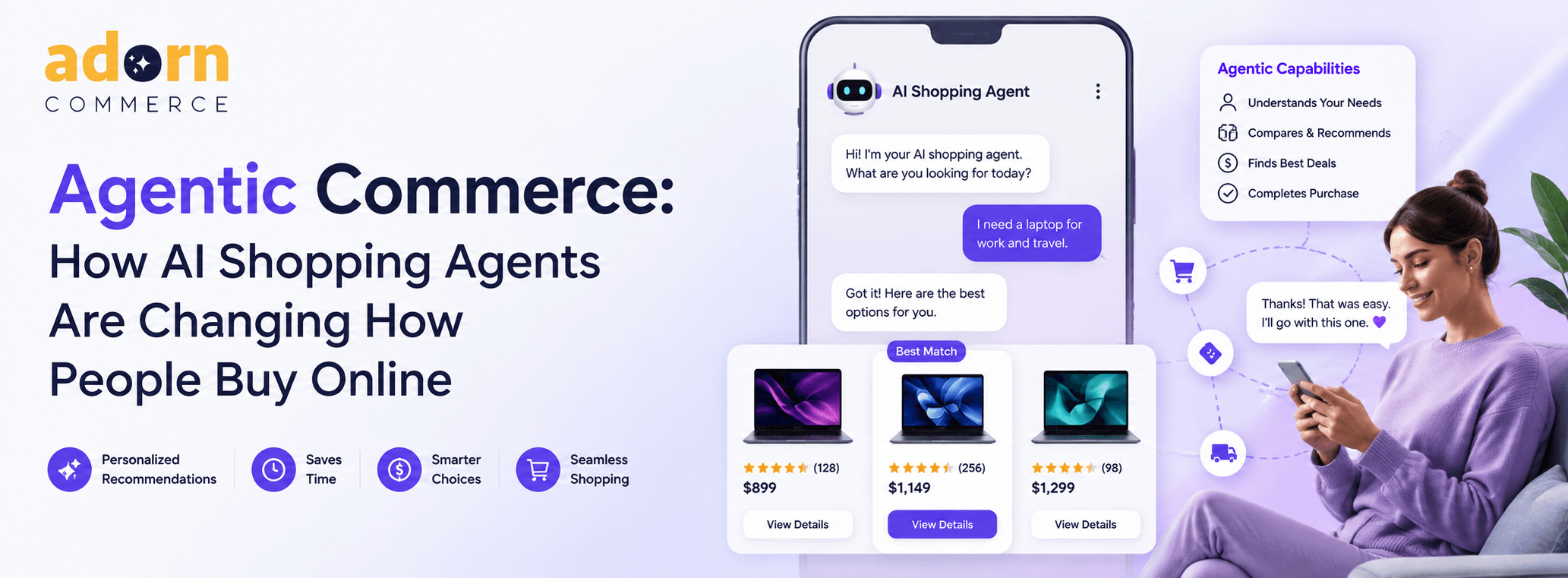
For the past two decades, "online shopping" has meant a person opening a browser, searching, comparing tabs, and clicking buy. Agentic commerce is the first real shift away from that model: an AI agent, acting on a shopper's behalf, does some or all of that work itself, researching options, comparing prices, and in some cases completing the purchase, inside a conversation rather than a storefront. It's a meaningfully different interaction than someone asking a chatbot for advice and then going to buy the product themselves. The agent is taking the action, not just giving the recommendation.
Where This Is Already Happening
This isn't a future scenario, it's live today across several major platforms. OpenAI has rolled out in-chat checkout in ChatGPT, letting people complete a purchase from participating merchants without leaving the conversation. Google has been building AI-powered shopping into Search and introduced the Agent Payments Protocol (AP2), an open standard developed with a large group of payment and commerce partners, so AI agents can make purchases in a secure, verifiable way. Perplexity has shipped its own in-answer shopping and checkout experience. These are separate efforts from separate companies, but they're all pointing at the same destination: the agent doesn't just inform the purchase, it can execute it.
Why Payment Networks Are Racing to Build Agent Protocols
An AI agent making a purchase on someone's behalf raises an obvious question: how does a merchant know the agent is actually authorized to spend that money? Visa, Mastercard, and other payment networks have been building their own agent-commerce frameworks for exactly this reason, essentially a secure, verifiable way for a payment credential to be handed to an agent for a specific purchase, without every merchant having to build a custom integration with every AI platform. The details differ between initiatives, but the underlying problem they're all solving is the same: agentic purchases need a trust layer that doesn't exist in a normal checkout flow.
The Real Shift: From Optimizing for Google to Optimizing for Agents
Here's the part that matters most for eCommerce brands. An AI agent doesn't browse a storefront the way a person does. It doesn't see your homepage design, your banner promotions, or your carefully written hero copy. It reads structured data, product feeds, schema markup, availability, pricing, shipping information, pulled directly from your site or a connected feed. A store with clean, complete, machine-readable product data gets considered by the agent. A store without it can be functionally invisible to that agent, even if it ranks well in traditional search and looks great to a human visitor. Search Engine Optimization isn't going away, but it's no longer the only audience your site needs to be built for.
What This Means for Product Data and Feeds
In practice, this pushes a handful of technical fundamentals from "nice to have" to genuinely business-critical: complete and accurate Product schema markup on every page (price, availability, SKU, reviews), inventory and pricing data that's actually current rather than stale, consistent product identifiers across your catalog and any feeds you publish, and clean APIs that expose your product data in a structured way rather than only as rendered HTML. This is exactly the kind of foundation a headless, API-first architecture is built for, and it's a big part of why the investment in structured data and clean architecture pays off well beyond just search rankings.
Trust, Returns, and the New Checkout Risk Surface
None of this is fully settled yet, and it's worth being honest about that. Questions around fraud liability, return policies for agent-initiated purchases, and how much a shopper actually reviews before an agent completes checkout are still being worked out across the industry. Brands adopting agentic checkout early are, in effect, helping define these norms in real time. That's not a reason to ignore the trend, but it is a reason to treat it as an emerging channel to test and monitor rather than something to bet the whole business on overnight.
What eCommerce Brands Should Actually Do Right Now
You don't need to rebuild your entire store to start preparing. Start by auditing your structured data, most platforms have real gaps in Product schema coverage that are worth fixing regardless of agentic commerce. Make sure your pricing and inventory feeds are accurate and updated in near real time, not batch-updated once a day. If you're on an older, tightly coupled platform, start scoping what a more API-first approach would take, not as an emergency migration, but as a roadmap item. And treat this the same way you'd treat any new channel: measure what happens when agents do start referencing your catalog, rather than guessing.
This is squarely the kind of work our AI-driven eCommerce and SEO and digital marketing teams help clients with, making sure a store isn't just built for the shoppers browsing today, but for the AI agents that are already starting to shop on their behalf. If you want a straight answer on where your store actually stands, get in touch and we'll walk through it with you.